Primary Operative Indications
Discogenic low back pain with ALL of the following:
Pain arising from 1 or 2-level disc disruption involving L3-4, L4-5, and/or L5-S1 segments
Presence of symptoms 6 months or greater
Failed nonoperative management, including but not limited to:
>6 weeks of PT
injections, pain medications…etc.
Primary complaint of axial back pain, with a possible secondary complaint of lower extremity pain
Age 18-60
Contraindications
Presence of symptomatic degenerative disc disease at more than 2 levels
Facet joint arthropathy, with signs that primary source of pain is facet mediated
Possible to perform in patients with asymptomatic facets with Pathria Grade 1-3, not Grade 4
Instability with spondylolisthesis greater than Grade 1
Presence of any pars defect
Leg pain predominance, chronic radiculopathy (unremitting pain with predominance of leg pain greater than back pain, extending over at least one year)
Osteopenia, DEXA T-score < or equal to -1.0
Possible for patients >~1.5 T-Score on Dexa scan
Hounsfield units as measured on CT, not as reliable
Poorly managed psychiatric disorder
Age >60 years or <18 years
Presence of infection or tumor
Moderate to severe scoliosis or major deformity
More than 40-50% loss of endplates surface area due to cysts or other severe endplate abnormality
Facet ankylosis
Metal allergy or history of implant rejection
AP length of vertebral body smaller than implant size
High risk anterior approach
Vascular calcification
Previous vascular surgery in area of anterior spine
Retroperitoneal radiation
Abarrant vascular anatomy
Obesity (varied based on surgeon experience)
Relative Contraindications (Debated)
3-level disease
Age >60 years possible with adequate bone quality without circumferential stenosis (Bertagnoli, 2006 )
Osteopenia, DEXA T-score < or equal to -1.0
Possible for patients >~1.5 T-Score on Dexa scan
Instability with spondylolisthesis greater than Grade 1
(Some surgeons would say that you should avoid lumbar ADR with any amount of anterolisthesis)
Retrolisthesis acceptable if Grade 1 or less
Facet joint arthropathy
Possible to perform in patients with relatively asymptomatic facets with Pathria Grade 1-3, not Grade 4
Prior laminectomy at lumbar ADR level
Scoliosis, >15degrees
Some surgeons tolerate scoliosis if no lateral listhesis at target disc, not at apex and <~15 degrees.
High sacral slope >~80 degrees, though some research says higher SS is not a contraindication (Arunakul, 2017 )
Important Outcome Considerations
Workup
Xray L-spine
AP view, used to match intraop AP rotation
Lateral, measure alignment for target sagittal balance
Flexion/Extension view, identify instability
EOS, consider full spine alignment
CT L-spine
Look for sclerotic endplates, may require sharper enplate cutter due to difficulty cutting through endplates
Some consider Spec-CT as an option to help identify painful level as it may correlate with active disc inflammation (not yet literature based)
MRI without contrast, L-Spine
Review disc degeneration
Review for stenosis or disc hernations
Review foraminal stenosis
Review health of the facets
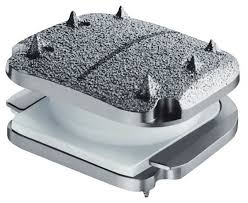
Implant Options
Current options
Historical options
Functional three-component
Functional two-component
Maverick by Medtronic
Flexicore by Stryker
XL TDR by NuVasive
Functional one-component
Freedom by AxioMed
M6-L by Spinal Kinetics
Cadisc-L by Ranier
LP-ESP by FH Orthopedics
Physio-L by K2m
Evidence
References
NASS Clinical Guidelines Jacobs W, Van der Gaag NA, Tuschel A, et al. Total disc replacement for chronic back pain in the presence of disc degeneration: a Cochrane review. Spine. 2013 Jan 1;38(1):24-36. doi: 10.1097/BRS.0b013e3182741b21.
Büttner-Janz K, Guyer RD, Ohnmeiss DD. Indications for lumbar total disc replacement: selecting the right patient with the right indication for the right total disc. Int J Spine Surg. 2014 Dec 1;8:12. doi: 10.14444/1012. PMID: 25694946; PMCID: PMC4325514. Yue JJ. Long-term prospective randomized outcomes following lumbar total disc replacement: a single site experience with 6 years follow-up; Paper presented at: ISASS16. April 6, 2016; Las Vegas, NV.
Meir AR, Freeman BJ, Fraser RD, Fowler SM. Ten-year survival and clinical outcome of the AcroFlex lumbar disc replacement for the treatment of symptomatic disc degeneration. Spine J. 2013;13(1):13-21. Lu SB, Hai Y, Kong C, et al. An 11-year minimum follow-up of the Charite III lumbar disc replacement for the treatment of symp- tomatic degenerative disc disease. Eur Spine J. 2015;24(9):2056-2064. Sköld C, Tropp H, Berg S. Five-year follow-up of total disc replacement compared to fusion: a randomized controlled trial. Eur Spine J. 2013;22(10):2288-95. FILE-ALT Ma L, Yang S, Wang H, Zhang D, Ding W. Two- and five-year follow-up of lumbar total disc replacement compared to fusion: a meta-analysis. Intl J Clin Exper Med. 2016;9(2):485-494 Radcliff K, Zigler J, Braxton E, et al. Final Long-Term Reporting from a Randomized Controlled IDE Trial for Lumbar Artificial Discs in Single-Level Degenerative Disc Disease: 7-year Results. Int J Spine Surg. 2021;15(4):612-32. FILE-ALT Zigler J, Gornet MF, Ferko N, Cameron C, Schranck FW, Patel L. Comparison of lumbar total disc replacement with surgical spinal fusion for the treatment of single-level degenerative disc disease: a meta-analysis of 5-year outcomes from randomized con- trolled trials. Global Spine J. 2017;8(4):413-423. FILE-ALT Harrop JS, Youssef JA, Maltenfort M, et al. Lumbar adjacent segment degeneration and disease after arthrodesis and total disc arthroplasty. Spine. 2008;33(15):1701-7. GragnanielloC,SeexKA,EisermannLG,ClaydonMH,MalhamGM.EarlypostoperativedislocationoftheanteriorMavericklumbar disc prosthesis: report of 2 cases. J Neurosurg Spine. 2013;19(2):191-6. Eskander MS, Onyedika II, Eskander JP, Connolly PJ, Eck JC, Lapinsky A. Revision strategy for posterior extrusion of the CHARITÉ polyethylene core. Spine. 2010;35(24):E1430-4. VanooijA,OnerFC,VerboutAJ.Complicationsofartificialdiscreplacement:areportof27patientswiththeSBCharitédisc.JSpinal Disord Tech. 2003;16(4):369-83. Kurtz SM, Van ooij A, Ross R, et al. Polyethylene wear and rim fracture in total disc arthroplasty. Spine J. 2007;7(1):12-21. MarnayTP.106.Seven-to21-yearclinicaloutcomesof1,187patientstreatedwithone-andtwo-levellumbartotaldiscarthroplasty. Spine J. 2021;21(9):S52. Rasouli A, Cuellar JM, Kanim L, Delamarter R. Multiple-Level Lumbar Total Disk Replacement: A Prospective Clinical and Radiographic Analysis of Motion Preservation at 24-72 Months. Clin Spine Surg. 2019;32(1):38-42. RehmatullahN,MorganC,GoruP,ShacklefordI.Singleandmultiplelevellumbardiscarthroplastyfordegenerativelumbardiscdisease: Outcome data at 24 months. Spine J. 2017;17(3):S8. Scott-YoungM,McEnteeL,ZottiM,etal.Patient ReportedOutcomeMeasuresAfterMultilevelLumbarTotalDiscArthroplastyfor the Treatment of Multilevel Degenerative Disc Disease. Spine. 2020 Jan 1;45(1):18-25. Hoff EK, Strube P, Pumberger M, Zahn RK, Putzier M. ALIF and total disc replacement versus 2-level circumferential fusion with TLIF: a prospective, randomized, clinical and radiological trial. Eur Spine J. 2016 May;25(5):1558-1566. doi: 10.1007/s00586-015- 3852-y. Epub 2015 Mar 7.
You Might Also Like