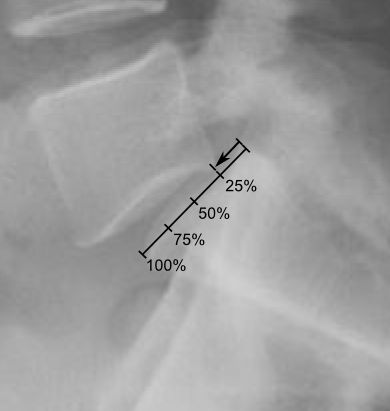
Degenerative Spondylolisthesis of the Lumbar Spine
Definition
- Anterior displacement of one vertebra over the caudal vertebra with degenerative changes and no disruption or defect in the vertebral ring
Symptoms
- Asymptomatic, or occasional back pain
- Chronic low back pain
- Neurogenic claudication secondary to stenosis and/or dynamic stenosis
- Radiculopathy and low back pain
- radiculopathy can be pain alone, sensory symptoms, or motor changes.
- Radiculopathy only
Imaging
- Xray L-spine 4+ views (AP, lateral, flexion, extension)
- AP view, used to match intraop AP rotation
- Lateral, measure alignment for target sagittal balance
- Flexion/Extension view, identify instability
- Some compare the standing lateral xray to a supine MRI sagittal image to look for motion
- EOS, consider global spine alignment
- If neurologic symptoms, MRI without contrast, L-Spine
- Review disc height and anterolisthesis grade
- Review facets, presence of effusion >1.5mm may suggest degenerative spondylolisthesis
- Presence of facet cysts and effusions are suggestive of degenerative spondylolisthesis
- 1mm facet effusion = 29.6% probably of degen spondy (Chaput 2007)
- 2mm facet effusion = 60.3%
- 3mm facet effusion = 84.6%
- Review pars to look for pars defect
- Review for central or lateral recess stenosis
- Review foraminal stenosis
- If unable to obtain MRI, consider CT myelography
- CT without myelography can still help evaluate for canal stenosis, but CT myelography is standard in patients who can not have an MRI
Classification
- Meyerding Classification: Determined by measuring the % of slip using standing, neutral lateral radiographs of the lumbar spine
- Severity grade
- Grade 5: >100% (spondyloptosis)
(Wikipedia)
Natural History
- Majority of patients with symptomatic degenerative lumbar spondylolisthesis and absence of neuro deficits do well with conservative care
- Patients with sensory changes, muscle weakness, or cauda equina are more likely to develop progressive functional decline without surgery.
- Progression of slip correlates with jobs that require repetitive anterior flexion of the spine.
- Progression less likely if disc has lost >80% of native height and intervertebral osteophytes have formed
- Progression of clinical symptoms does not correlate with progression of the slip
Treatment
- Nonoperative
- Activity restriction
- Meds
- NSAIDS
- Ibuprofen, naproxen, meloxicam
- Muscle relaxers
- Robaxin, flexeril, tizanidine
- Nerve pain meds
- Gabapentin (Neurontin), Pregabalin (Lyrica)
- Physical therapy
- Epidural steroid injections
- Second line if non-invasive treatment fails
- Transforaminal epidural steroid injections (TFESI)
- Targeting the traversing and/or exiting nerve root at the level of degenerative spondylolisthesis
- Lateral recess stenosis is common, so targeting bilateral traversing nerve roots are a common target or unilateral if symptoms are one-sided.
- Example: L4-5 degenerative spondy = bilateral L5 nerve root TFESI
- Operative Treatment
- Posterior lumbar decompression alone
- Indications
- Usually not indicated due to instability (NASS Guidelines)
- Stable grade 1 spondy in elderly, unhealthy patient with poor bone quality
- Contraindications
- Unstable spondylolisthesis
- Outcomes
- Decompression with preservation of midline structures
- Indications
- Symptomatic single-level degenerative spondylolisthesis that is low grade (<20%) and without lateral foraminal stenosis
- Stable <~2-4mm of motion of spondy on flexion/extension xrays, or flexion xrays and supine MRI
- Outcomes
- Equivalent outcomes to decompression with fusion
- Instrumented fusion with decompression +/- anterior cage
- Indications
- Symptomatic spinal stenosis with degenerative spondylolisthesis
- Consider middle column height restoration with cage for up/down foraminal stenosis
- Contraindications
- Outcomes
- Improved functional outcomes of single-level degenerative spondy compared to medical/interventional treatment alone (Allen, 2009)
- Increased fusion rates with instrumented fusion + decompression, but no difference in clinical outcomes when compared to non-instrumented fusion + decompression (Fischgrund, 1997)
- Indirect decompression (LLIF, OLIF)
- Indications
- Symptomatic grade 1-2 degenerative spondy with stenosis that improves with sitting or lying down and/or up-down foraminal stenosis
- Contraindications
- Severe stenosis with symptoms present in any position
- Grade 3 and higher slip
- Autofused level
- Outcomes
- Multi-level spondylolisthesis
- Fusion with decompression (Insufficient evidence)
References
- NASS Clinical Guidelines Degenerative Spondylolisthesis
- Chaput, 2007
- Fischgrund, 1997
- Allen, 2009